4
Featured systems
Academic profile
Portfolio overview
Research software, analytical pipelines, and supporting systems connected to forecasting, outbreak modelling, data engineering, and bibliographic workflows.
4
Featured systems
14
Public repositories
15
Tracked project records
106
Cumulative stars
The portfolio foregrounds featured systems first, then moves into supporting infrastructure.
Systems
These systems are the research software that supports the published work.
Research code
Multimodal time-series forecasting framework for respiratory disease activity and early-warning scenarios, reporting R² = 0.956 on over 11 years of Hong Kong influenza data (excluding COVID-19).
Research framework connecting multimodal respiratory-disease forecasting with transparent model-evaluation and published output.
Research code
ODE and Petri Net dual-model research workflow for the 2025 Foshan chikungunya outbreak, published in BMC Public Health 26 (2026).
Dual-model outbreak analysis workflow linking mechanistic interpretation, intervention phases, and manuscript development.
Research code
Multi-region and multi-window influenza co-circulation analysis workflow, published in npj Systems Biology and Applications (2026).
Analytical pipeline supporting work on influenza co-circulation, multi-subtype interaction, and non-stationary time-series modelling.
Software
Cross-platform BibTeX verification and metadata-completion tool for researchers and AI assistants. CLI, Python API, MCP server, and explainable multi-source matching. Published on PyPI.
Utility for reference verification, metadata completion, deduplication, and citation cleanup across writing workflows.
Infrastructure
Supporting tools and repositories extend the research stack without being presented as separate polished demos.
Platform
Crawler, database, ETL, and visualization stack for infectious-disease news collection, monitoring, and research support. Includes public and private components.
Research code
Supplementary codebase for the Fujian dengue-vector Breteau Index prediction study, published as a Research Square preprint.
Analysis project
Team solution and codebase for the 2023 Mathematical Contest in Modeling (MCM) Problem C.
Software
GUI-equipped Baidu Index scraping tool for data collection workflows.
Software
Refactored LaTeX template for the China Graduate Mathematical Contest in Modeling (Huawei Cup).
Research code
Crawler for the Public Health Science Data Center (phsciencedata.cn) regional and age-stratified disease datasets.
Platform
Static deployment of the public EPIC dashboard for infectious-disease situational awareness.
Software
Evidence-first research workflow harness with six plugins (science-core / science-compute / science-data / science-epi / science-literature / science-verify), human-gated research stages, and append-only provenance logs.
Software
Mainland China-first legal workflow plugin pack for Claude Code (contract review, litigation support, compliance, corporate, labor, IP) with statute checks and citation gates.
Research code
Local-first research harness for building, benchmarking, and improving auditable outbreak-intelligence agents under deterministic public-health safety constraints (fail-closed publication, evidence binding, no autonomous approval).
Research code
Reproducible, auditable viral-outbreak research workspace (Hantavirus, Ebola) with DVC + Snakemake + MLflow ResearchOps and data-provenance grading.
Capabilities
The current portfolio emphasizes methods, systems, and outputs rather than screenshots or interactive demos.
Multimodal prediction, early-warning framing, decomposition-based workflows, and respiratory disease signal modelling.
ODE and Petri Net outbreak analysis with intervention-oriented interpretation under small-sample conditions.
Crawler pipelines, ETL, database workflows, visualization support, and research-oriented monitoring infrastructure.
Bibliographic validation, metadata normalization, and support tooling for evidence-driven writing workflows.
Activity
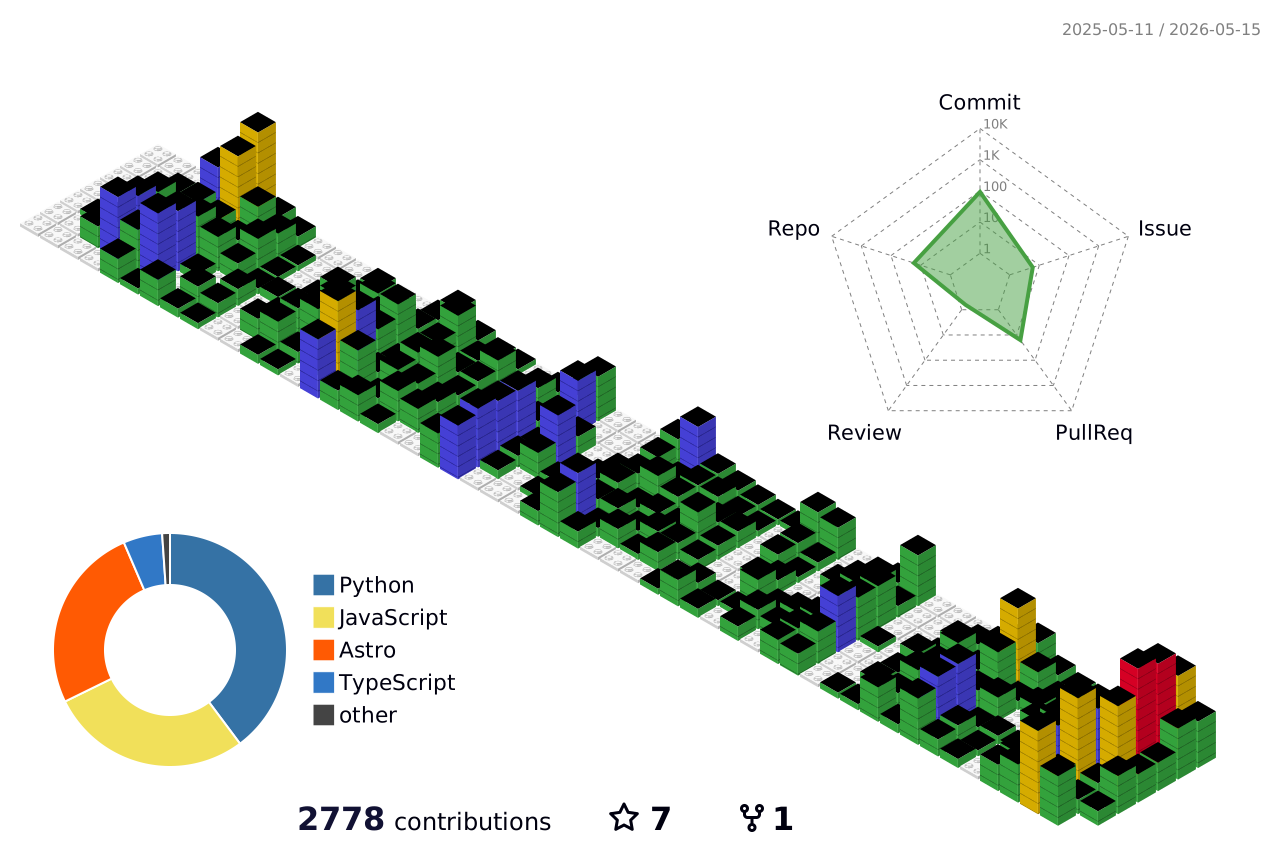
Live GitHub activity, pinned research repositories, and the day-to-day research stack.